
India's 8 percent-plus growth has opened up opportunities where India is, for the first time, in a position to offer unprecedented opportunities to US businessmen in the nuclear power, space and manufacturing sectors.
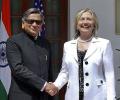
US Secretary of State Hillary Clinton after the second round of Indo-US Strategic Dialogue with her counterpart S M Krishna, made it very clear that there were "issues" which required to be resolved by the two sides in the civil nuclear field. But she did not go into the specifics.
United States President Barack Obama has no plans to travel to Pakistan when he visits India and other Asian nations in November this year.
Implementing the commitment of United States President Barack Obama to deepen Indo-US strategic ties, the White House has carved out a separate India Desk at its National Security Council.
Retired Commodore Uday Bhaskar, leading strategic analyst, has predicted that the Indo-US relationship 10 years into the future will still remain on track even if the bilateral civilian nuclear deal is not consummated because it is now driven largely by non-government actors.
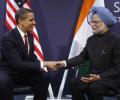
Prime Minister Manmohan Singh had his first substantive meeting with President Barack Obama on Thursday, during which he told the American leader that India would like to carry forward the Indo-US strategic relationship that had developed during the last five years.
Jiabao indicated that a red-carpet welcome awaited Manmohan Singh, who is expected to visit China this year
US President-elect Barack Obama is a solid supporter of the growing Indo-US strategic partnership and backs the landmark bilateral nuclear deal, but has strong views about outsourcing of American jobs overseas, a cause of concern for Indian businesses.
"The N-deal is not only the highest visible symbol of cooperation between India and the United States, it represents a new turn -- it is a very special cooperation."
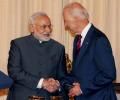
The two leaders agreed to work closely to further advance the India-US Comprehensive Global Strategic Partnership, built on shared values and common interests, it added.
Addressing a joint press conference in Washington along with Pakistan Foreign Minister Shah Mehmood Qureshi, US Secretary of State Hillary Clinton said that over the next few days the strategic talks will focus on Pakistan's energy and water needs.

John Kerry, US Secretary of State, who is here for the 2nd Indo-US Strategic and Commercial Dialogue, said his country would want its civil nuclear cooperation with India to take shape in setting up of reactors.

Slogans like 'Vande Mataram', 'Bharat Mata ki Jai' and 'Modi, Modi' went up the air amid a mood of cheer.

Modi assured Trump that India will try to 'live up to the expectations' of the US and the world and also thanked the US President for speaking 'highly' about India during his trips.
The commonalities of interests are immense for growth in trade between India and the US.
Biden and Modi committed that the US and India will work closely together to win the fight against the COVID-19 pandemic, renew their partnership on climate change, rebuild the global economy in a way that benefits the people of both countries, and stand together against the scourge of global terrorism, the White House said in a readout of the call.
The PMO issued a press release virtually repeating its earlier assurances that the deal did not undermine India's nuclear sovereignty or did any harm to the country's interest. At a press conference later, Singh said the prime minister should come out with a public statement either in Parliament or outside assuaging their concerns as they were not in a position to support the deal as of now.

In perhaps the first major conference on the United States-India strategic partnership in the aftermath of the Khobragade controversy that plunged the bilateral relationship in a downward spiral and is now in the process of being resurrected, the undeniable consensus among the panelists and participants was that much ballyhooed strategic convergence between Washington and New Delhi has dissipated.
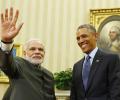
When President Obama lands in New Delhi later this week, this spirit of accommodation must reignite a strategic economic relationship between the two countries.

According to the Biden-Harris Transition, 'the president-elect noted that he looks forward to working closely with the prime minister on shared global challenges, including containing COVID-19 and defending against future health crises, tackling the threat of climate change, launching the global economic recovery, strengthening democracy at home and abroad, and maintaining a secure and prosperous Indo-Pacific region'.

Modi also gifted Harris a 'gulabi meenakari' chess set, the sources said, adding that the craft of 'gulabi meenakari' is closely associated with Varanasi, one of the oldest cities of the world and the prime minister's Lok Sabha constituency.
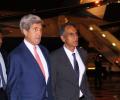
Officials sought to downplay the incident saying the convoy was not stuck but had only slowed down due to heavy traffic and rainfall.

The last meeting of the 2+2 was held in New Delhi and the next meeting is to be hosted by the US in Washington, DC.
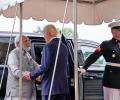
Prime Minister Narendra Modi and President Joe Biden will have a one-on-one meeting in the Oval Office of the White House on Thursday before holding high-level talks to further boost the growing Indo-US strategic relations in areas like defence, space, clean energy and critical technologies.
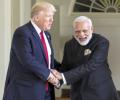
US President Trump "presented the Legion of Merit to Indian Prime Minister Narendra Modi for his leadership in elevating the US-India strategic partnership," O'Brien said in a tweet.
Pak-US ties are sliding down the hill due to difference over handling of peace issue in Afghanistan and US' growing defence tie with India.

Prime Minister Narendra Modi held talks with US President Joe Biden at the White House on Thursday to discuss a wide range of issues of mutual and global interests, aimed at further boosting the Indo-US strategic relations in areas like defence, space, clean energy and critical technologies.

The Obama administration has christened his vision of Indo-US ties that has overcome the "hesitations of history" and working for the betterment of the global good as "Modi Doctrine".

Concluding his whirlwind tour of Silicon Valley, Prime Minister Narendra Modi on Monday left for New York where he will have a packed schedule that includes talks with US President Barack Obama.
Doubts about the Obama administration's commitment to a strategic partnership with India were raised by the likes of Lalit Mansingh, former Indian ambassador to the US and former Indian foreign secretary, and Kanwal Sibal, former Indian foreign secretary and former deputy chief of mission in Washington, DC, in two separate panels titled 'American and Indian Strategic Interests in Asia' and 'Where is the US-India Strategic Relationship Headed in the Coming Year?'
"On space, we will be able to announce that India is signing the Artemis Accords, which advance a common vision for space exploration for the benefit of all humankind," a senior administration official said hours before the meeting between Prime Minister Narendra Modi and President Joe Biden in the Oval Office.
The full text of the Indo-US joint statement released in New Delhi.

The Quad summit to be hosted by India in 2024 is likely to enhance New Delhi's strategic intent.
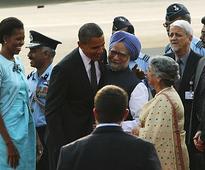
After the second US-India strategic dialogue, Aziz Haniffa finds growing concern about the civilian nuclear deal trapped in limbo.

"He (Biden) is very much part of this period when Indo-American relations underwent a radical transformation, which I reasonably date back to (Bill) Clinton's visit," Jaishankar said.

'Recalling his visit as the chief guest at India's Republic Day celebrations in 2015, President Obama wished the Prime Minister warm congratulations ahead of India's upcoming 68th Republic Day anniversary,' the White House said.
'The relationship between India and the United States has always been one that seemed obvious -- that seemed like a no-brainer and seemed like it's something that should have happened a generation ago.'
